Personal Example
My gender is somewhat complex, which makes it great to use for an example of how the system works. As such, for this example, I will be explaining my own gender using multiple graphs to represent multiple different aspects of my gender identity.
I’m going to use Four different axes to describe my gender. They will be:
M: Masculinity
F: Femininity
C: Cisgender-ness
Q: Queergender-ness
I will order the axes on my graph like so: (M, F, C, Q).
As sha, you may use any axes you need to describe your gender. For me, I am choosing to have an axis on cisgenderness, as I have had such a long history with my gender that I’ll never be able to fully consider myself cisgender, while still aligning closely to my AGAB. For me, the aspect of cisgenderness is separate to masculinity and femininity.
I also have an axis for queergenderness, which I have chosen to include, since I verbally call myself queergender. Along with this, I see it as separate to my cisgenderness, as I feel both intensely cisgender and genderqueer. My queergender identity doesn’t make me less cisgender.
Let's look at where I place on the two different graphs I have created to show my identity.
Masculinity-Femininity
For starters, let’s show where I am on a graph that has an axis for masculinity and an axis for femininity.
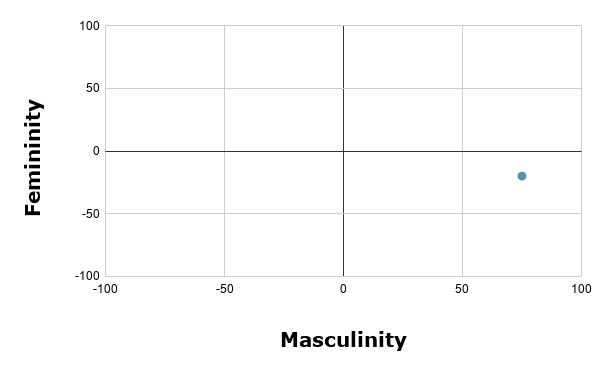
Most people should be able to pinpoint their identity somewhere on this graph.
As you can see, this chart has four quadrants, and both axes have the lowest point being -100, and the highest point being 100. This range was arbitrarily chosen for the example, but is the range I’d recommend most people use for ease of communication and understanding.
On this graph, -100 will represent the term “negatrois,” while 100 will represent the term “positrois”. As such, a person who is at the point (100, 0) could be referred to as boy-positrois, positive-boy, posiboy, or any other way that makes him comfortable. They could also be girl-negatrois, negative-girl, negagirl, or any other way that makes them feel affirmed, including using terms such as “euboy” or “antigirl”.
On this graph I have placed myself at around the point (75, -20), which means my gender has a positive charge of 75 on the masculine axis, and a negative charge of 20 on the feminine axis. This aligns my masculinity with a positrois identity. As such, I will refer to myself as a posiboy, as that term personally makes me comfortable. This also aligns my femininity with a negatrois identity. As such, I will refer to myself as a girl-negative, as that personally makes me comfortable.
Cisgenderness-Queergenderness
Now, let's look at a graph with an axis for cisgenderness and an axis for queergenderness.
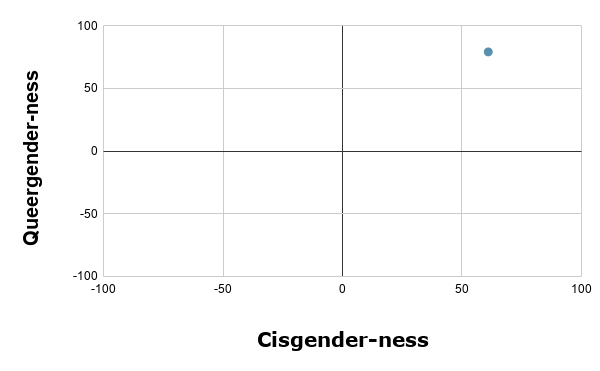
On this graph I have placed myself at around the point (61, 79), which puts me at a positive charge of 61 on the cisgender axis, and a positive charge of 79 on the queergender axis. With my cisgender axis being positrois, I could call myself cis-positive and queer-positive. In fact, I could even combine these to call myself cisqueerpositive if I wanted to.
With all of this data (from this graph AND from the previous graph), I would be at the point (75, -20, 61, 79) on my graph, and I could refer to myself with leptral terminology as “cisqueerpositive girl-negative posiboy.” This means that I am a cis, genderqueer man, who is not at all a girl.